
GEPCO New Connection: Application, Documents and Demand Notice Explained:-
Applying for a GEPCO new connection is no longer a matter of repeated visits to the subdivision office. The Electricity New Connection portal, used by every distribution company in Pakistan, lets you submit the application, upload documents, download the demand notice and track progress from home.
That said, the portal only handles the paperwork. Most delays happen elsewhere — an incomplete document set, a wiring test report that never arrives, or a demand notice paid but never uploaded. This guide covers the whole process in order, with the specific points where applications stall.
Who Can Apply, and for What:-
GEPCO accepts applications from property owners, authorised landlords and tenants holding the owner’s written permission, along with businesses, corporate entities and government organisations. Tenants should note that the connection is registered against the property, so the owner’s consent is not a formality you can skip.
Connection categories mirror the tariff structure: domestic for homes, commercial for shops and offices, industrial for manufacturing units, agricultural for tube wells, and temporary supply for construction sites or events. Choose carefully at the application stage — the category determines your documents, your load requirements and, permanently, your tariff.
Since sanctioned load now drives a fixed monthly charge under the current two-part tariff, it also pays to request a load that reflects genuine need rather than the largest figure available. Over-specifying costs you every month for the life of the connection.
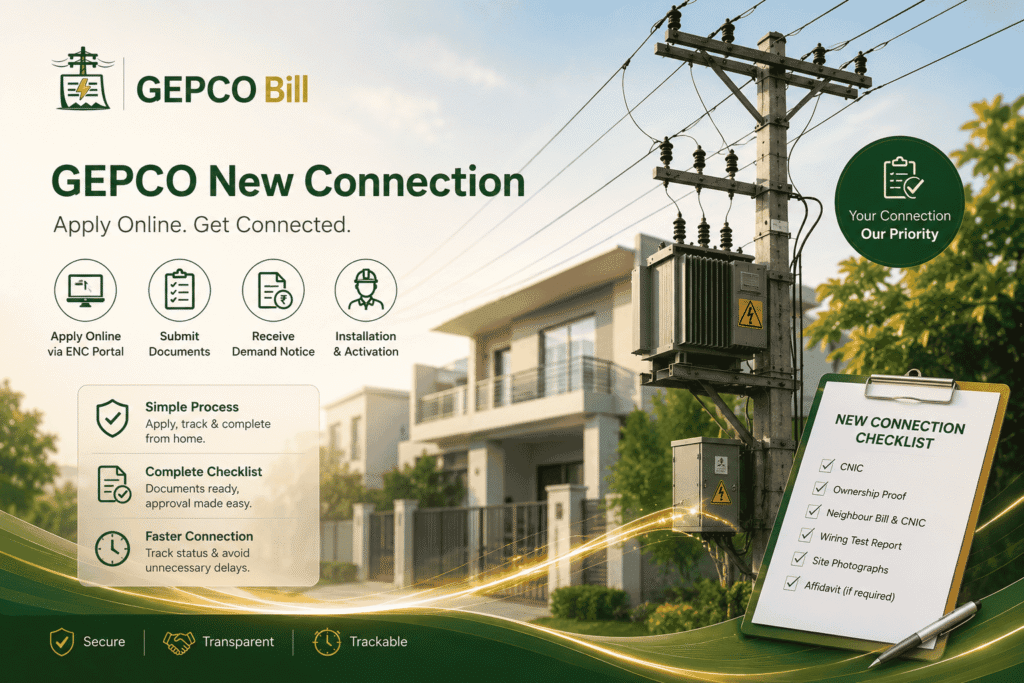
Documents You Need Before Applying:-
| Document | What It Must Show | Common Mistake |
|---|---|---|
| Applicant CNIC | Attested photocopies, clearly legible | Expired CNIC, or attestation missing |
| Ownership proof | Registry, allotment letter, sale deed, or lease with owner consent | Unregistered agreement offered as ownership proof |
| Neighbour's electricity bill | A recent bill from the adjacent connection | Bill too old, or reference number unreadable |
| Neighbour's CNIC copy | Attested photocopy | Neighbour unwilling; ask early, not on submission day |
| Wiring test report | Issued by an approved electrician after internal wiring | Applying before wiring is finished |
| Site photographs | Premises and the nearest pole, where requested | Blurred images that fail verification |
| Affidavit on stamp paper | Where the property is not registered in your name | Wrong stamp value, or unattested |
Gather the neighbour's bill and CNIC first — they're the two items most likely to delay submission since they depend on someone else's cooperation.
The neighbour’s bill surprises most first-time applicants. GEPCO uses it to identify your exact location and the transformer that will feed your connection, so it is a technical requirement rather than bureaucratic decoration. Arrange it before you start.
Commercial and industrial applications need more: business registration or an NTN certificate, a load calculation sheet for higher loads, and sometimes a site plan. Ask your subdivision office what your specific load band requires, because the answer varies.
How to Apply Through the ENC Portal:
- Open the Electricity New Connection portal and select GEPCO as your distribution company.
- Choose your connection type and the load you require in kilowatts.
- Complete the application form with your CNIC number, full address and contact details. Enter the address exactly as it appears on your ownership document.
- Upload the scanned documents from your checklist. Scan in good light — rejections for illegible uploads are common and cost a week each time.
- Submit and save the tracking ID immediately. Photograph it or email it to yourself. Losing it is the single most avoidable delay in the whole process.
- Print the completed form for your own records, and submit hard copies to the subdivision office if it asks for them.
You can still apply manually at the subdivision office named on any neighbouring bill. The document set is identical; only the submission route differs. Manual applicants should insist on a stamped receiving copy, which serves the same purpose as the tracking ID.
The Survey and the Demand Notice:-
After submission, GEPCO carries out a site survey. A lineman visits to confirm the address, assess the distance from the nearest pole, and verify that your internal wiring is complete and safe. Applications routinely stall here because nobody is on site when the surveyor arrives, so keep your phone available and someone present.
The demand notice follows the survey. It is the formal cost estimate for connecting you, and it carries a payment deadline. Miss that deadline and the application can lapse, forcing a fresh start.
Indicative costs, which vary with load and site conditions:
| Connection Type | Typical Demand Notice Range | Generally Covers |
|---|---|---|
| Domestic, single phase | Approx. Rs 9,000 – 12,000 | Meter plus roughly 40 metres of service cable |
| Domestic, three phase | Approx. Rs 36,000 – 50,000 | Three-phase meter and associated equipment |
| Commercial | Higher, load dependent | Meter, equipment and security deposit |
| Industrial | Substantially higher | Equipment, security and any infrastructure work |
Treat these as ranges, not quotations. If your premises sit well beyond the standard cable allowance, or the connection requires a new pole or transformer capacity, the notice rises accordingly. The schedule of charges also changes periodically, so your notice governs — not any figure you read online, including this one.
Pay only through the banking channels named on the notice, and keep the receipt. Then upload the paid receipt through the portal, or hand it to the subdivision office. This upload step is missed constantly, and the file simply sits until someone notices.
Installation and Your First Bill:
Once the paid notice is recorded, GEPCO schedules meter installation. Timelines depend on workload, material availability and site readiness; straightforward domestic connections in serviced areas move fastest, while anything needing new infrastructure takes considerably longer.
When the meter goes in, photograph it immediately — the meter number and the opening reading. That photograph is your baseline, and it settles any later dispute about consumption in the first cycle.
Your first bill arrives after the next reading cycle and often covers an odd number of days, which makes it look unusual. Use the bill calculator to sanity-check it once you know your units, and note your reference number somewhere safe, since you will need it for every future bill check and payment.
Tracking Your Application
The ENC portal shows the current stage against your tracking ID or CNIC — submitted, under survey, demand notice issued, payment received, or installation scheduled. Check it before travelling to the office, because the portal usually tells you exactly what is outstanding.
If the file has not moved for several weeks with no explanation, raise it with the subdivision office in writing and keep the stamped copy. Unreasonable delay in providing a new connection is a matter you can escalate to NEPRA, and applications tend to move once a regulator reference exists.
Five Delays Worth Avoiding
- Applying before the internal wiring is finished. Without a wiring test report the file cannot progress past survey.
- Losing the tracking ID. Recovery is possible but slow, and it costs you the ability to check status independently.
- Missing the demand notice deadline. A lapsed notice can mean reapplying from the beginning.
- Paying the notice but never uploading the receipt. The system does not know you paid until the receipt is recorded.
- Choosing the wrong connection category to save money. A domestic meter on commercial premises invites a detection bill and a tariff correction later.
One further caution: nobody needs to be paid privately to move your file. The process is free beyond the demand notice and any documented charges, and every stage is trackable online. Anyone offering to accelerate the process for a fee is not part of it.
Frequently Asked Questions
Apply through the Electricity New Connection portal, select GEPCO, choose your connection type and load, upload your documents, then save the tracking ID. GEPCO conducts a site survey, issues a demand notice, and schedules meter installation once you pay it and upload the receipt.
At minimum: attested copies of your CNIC, proof of ownership or a lease with the owner's consent, a recent electricity bill from a neighbouring connection, an attested copy of the neighbour's CNIC, and a wiring test report. Commercial and industrial applications additionally need business registration or an NTN certificate and, for larger loads, a load calculation sheet.
A single-phase domestic demand notice commonly falls in the Rs 9,000 to 12,000 range, and a three-phase notice considerably higher, typically Rs 36,000 to 50,000. These are indicative only. The actual figure depends on your load, the distance to the nearest pole and the current schedule of charges, and the notice GEPCO issues to you is the authoritative amount.
A straightforward domestic connection in an already-served area typically moves through survey, demand notice and installation over several weeks. Delays cluster around incomplete documents, missed surveys and unrecorded payments. Connections needing new poles or transformer capacity take substantially longer.
Yes, with the owner's written permission and a valid lease. The connection remains attached to the property rather than to you, so agree with the owner in advance about what happens to the connection and any security deposit when the tenancy ends.
It is the formal cost estimate GEPCO issues after surveying your site, setting out what you must pay before installation and by when. Pay it through the banking channels named on the notice, keep the receipt, and upload it — an unrecorded payment leaves the application stalled.
Yes, through the ENC portal using your tracking ID or CNIC. It shows the current stage, which usually tells you exactly what is outstanding without a trip to the office.
No. Under the current two-part tariff, sanctioned load drives a fixed monthly charge you pay whether or not you use the capacity. Request what your appliances genuinely require. If your needs grow later, apply for a load extension rather than over-specifying now.
Prepare Once, Apply Once
A GEPCO new connection is a document exercise more than a technical one. Collect the full set before you open the portal, finish your internal wiring first, guard the tracking ID, and upload the paid demand notice the same day you pay it. Applications that follow that sequence usually run without incident — and the ones that stall almost always trace back to a step skipped at the beginning.