
How to Read Your GEPCO Bill: Every Line Explained
Knowing how to read your GEPCO bill helps you spot errors, avoid late fees and understand why the amount changes every month. This guide walks through each section, from the reference number at the top to the payable amount at the bottom, using the labels printed on the bill itself.
For the best results, open your own bill with our GEPCO online bill check and follow along section by section.
On this page
- How to Read a GEPCO Bill in Five Parts
- Part 1: Consumer and Connection Details
- Part 2: How to Read the Dates on Your GEPCO Bill
- Part 3: How to Read Meter Readings and Units on a GEPCO Bill
- Part 4: How to Read the Electricity Charges on a GEPCO Bill
- Part 5: How to Read the Taxes on a GEPCO Bill
- Totals: How to Read Arrears and the Payable Amount on a GEPCO Bill
- The 12-Month History Table
- Worked Example: How to Read a 300-Unit GEPCO Bill
- Mistakes to Look For on Your GEPCO Bill
- Frequently Asked Questions on How to Read a GEPCO Bill
- Now You Know How to Read a GEPCO Bill
- More GEPCO Guides
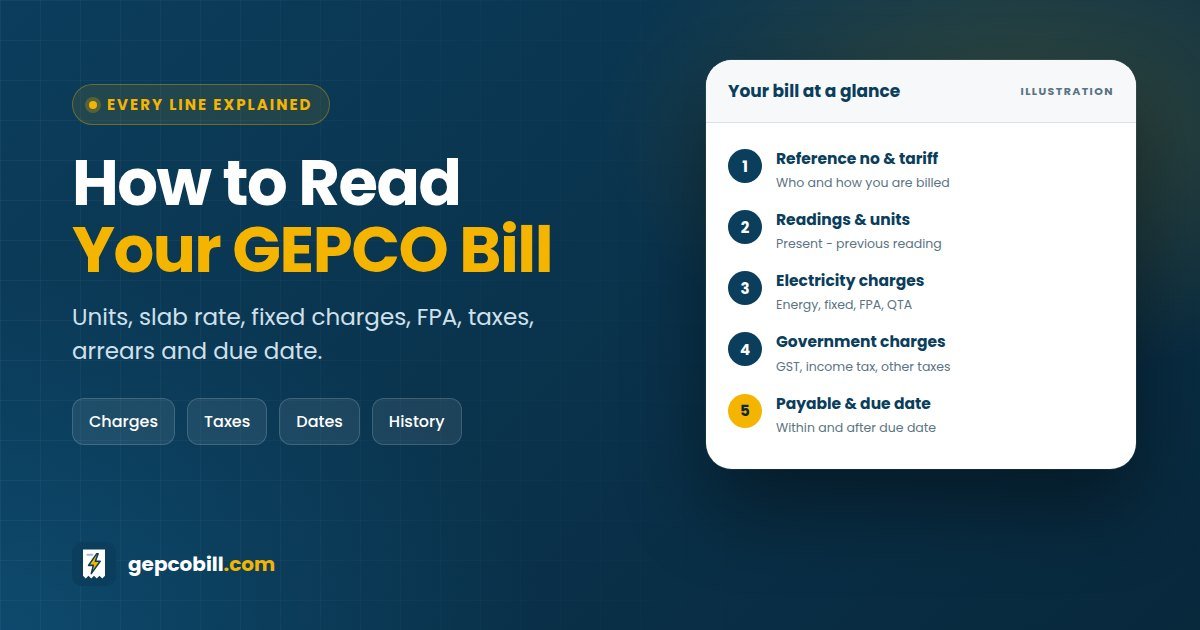
How to Read a GEPCO Bill in Five Parts
Every GEPCO bill follows the same structure. Once you know the five parts, you can find any figure in seconds.
- Consumer details: who is billed, and on which tariff and load.
- Dates: the bill month, reading date, issue date and due date.
- Meter readings: previous and present readings and the units you used.
- Charges and taxes: electricity charges, adjustments and government taxes.
- Totals and history: arrears, payable amounts and the 12-month history.
Part 1: Consumer and Connection Details
The top block tells you whose connection this is and how GEPCO bills it. Check it first, because a wrong tariff or load affects every other line.
| Label on the bill | What it means | What to check |
|---|---|---|
| REFERENCE NO | Your 14-digit account number, with U (urban) or R (rural) | Use it for online checks and payments |
| CONSUMER ID | A second, 10-digit customer number | Also works in the online bill check |
| TARIFF | Your rate category, for example A-1a(01) for an ordinary home | A home should not be on a commercial tariff |
| LOAD | Your sanctioned load in kW | It sets your monthly fixed charge |
| CONNECTED LOAD | The load of appliances recorded for your premises | Should be close to your real use |
| DIVISION / SUB DIVISION | The GEPCO offices responsible for you | Where to go for complaints |
| FEEDER NAME | The power line that supplies your area | Useful when reporting an outage |
| CONNECTION DATE | When the connection started | Confirms the account’s age |
If the tariff or load looks wrong, raise it early. A home wrongly billed on a higher load pays a bigger fixed charge every month.
Part 2: How to Read the Dates on Your GEPCO Bill
| Label | What it means |
|---|---|
| BILL MONTH | The month this bill is for |
| READING DATE | The day the meter reader recorded your present reading |
| ISSUE DATE | The day the bill was generated |
| DUE DATE | The last day to pay the lower “within due date” amount |
The gap between two reading dates should be about 30 days. NEPRA has fined DISCOs, including GEPCO, for billing periods longer than that, because a longer period pushes more units into a higher slab.
Part 3: How to Read Meter Readings and Units on a GEPCO Bill
This is the most important section, since units drive most of the bill. Here is how the figures fit together.
| Label | What it means |
|---|---|
| METER NO | The serial number of your meter |
| PREVIOUS READING | The reading on last month’s reading date |
| PRESENT READING | The reading on this month’s reading date |
| MF | Multiplying factor; for normal home meters it is 1 |
| UNITS | (Present − previous reading) × MF |
| STATUS | The reading status recorded by the meter reader |
For example, a present reading of 14,520 and a previous reading of 14,220 with an MF of 1 gives 300 units. NEPRA also requires bills to show a snapshot of the meter reading, so you can compare the photo with the printed figure.
How to check that your units are right
If your meter shows less than the bill’s present reading, GEPCO has billed you ahead of time. Take a dated photo of the meter and follow our GEPCO complaint guide.
Part 4: How to Read the Electricity Charges on a GEPCO Bill
These lines are what you pay GEPCO for the electricity itself. Together they form the base that GEPCO uses to work out tax.
| Label | What it means |
|---|---|
| COST OF ELECTRICITY | Units × the NEPRA rate for your slab (the energy charge) |
| FIX CHARGES | Your sanctioned load in kW × the fixed rate for your slab; none for lifeline homes |
| METER RENT / SERVICE RENT | Small monthly rents where they apply; often zero on home bills |
| FUEL PRICE ADJUSTMENT | The FPA: units × NEPRA’s monthly fuel adjustment (Rs 2.0581 in September or October 2026 bills) |
| F.C SURCHARGE | The government’s debt service surcharge: Rs 3.23 per unit for most homes, Rs 0.43 for protected homes, none for lifeline |
| QTR TARIFF ADJ / DMC | The quarterly tariff adjustment (Rs 0.5194 per unit for September–November 2026 bills) |
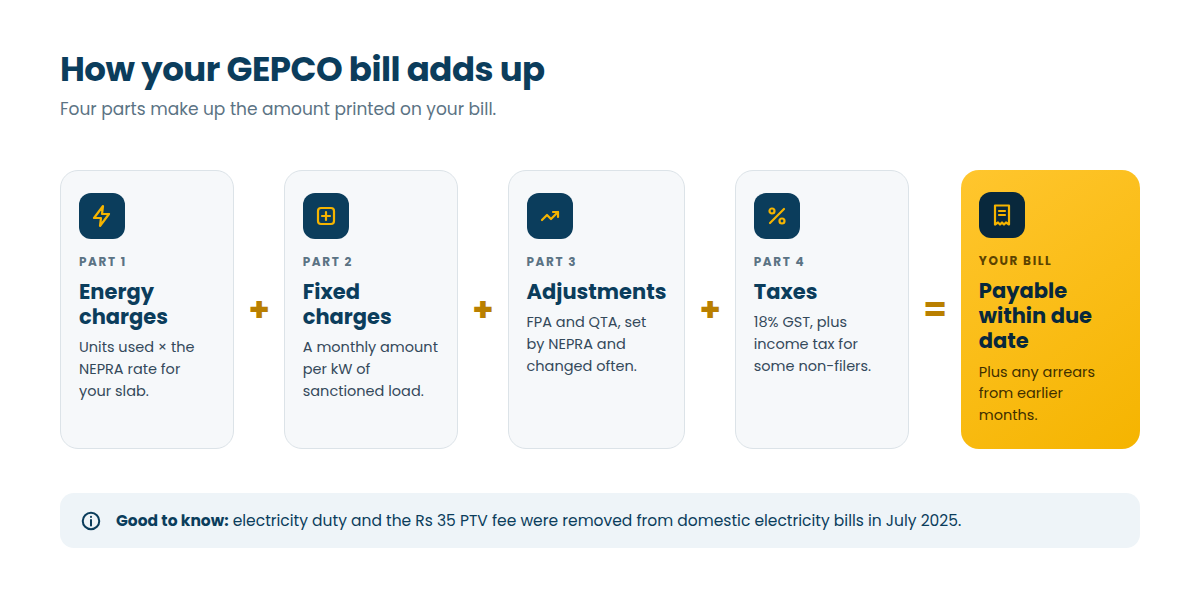
The FPA and quarterly adjustment can be negative in months of relief. For the current rates behind each line, see our GEPCO unit price page, or NEPRA’s own guide to electricity bill items.
Part 5: How to Read the Taxes on a GEPCO Bill
This block lists the taxes collected on behalf of the government. For most homes, only GST appears; the others depend on tax status or connection type.
| Label | Who pays it | Current rate |
|---|---|---|
| GST | Everyone | 18% of the electricity charges |
| INCOME TAX | Domestic users not on FBR’s Active Taxpayers List | 7.5% when the bill is Rs 25,000 or more |
| FURTHER TAX | Unregistered commercial and industrial users | 4% |
| RETAILER STAX | Shops and retailers | 5% up to Rs 20,000, 7.5% above |
| EXTRA TAX | Some unregistered commercial users | Depends on the case |
| ELECTRICITY DUTY | No longer charged to homes in Punjab | Exempt since November 2025 |
| TV FEE | Nobody | Removed from 1 July 2025 |
If income tax appears even though you are a filer, the CNIC or NTN on your connection may not match FBR’s Active Taxpayers List. Ask your sub-division office to update it.
Totals: How to Read Arrears and the Payable Amount on a GEPCO Bill
The bottom block brings everything together and tells you exactly what to pay.
| Label | What it means |
|---|---|
| ARREAR / AGE | Unpaid amounts from earlier bills and how old they are |
| CURRENT BILL | This month’s charges and taxes |
| BILL ADJUSTMENT | A correction added or credited by GEPCO |
| INSTALLMENT | A part-payment of an earlier amount spread over months |
| SUBSIDIES | Any government relief applied to your bill |
| DEFERRED AMOUNT | An amount postponed to later bills |
| L.P. SURCHARGE | The late payment surcharge added after the due date |
| PAYABLE WITHIN DUE DATE | The amount to pay on or before the due date |
| PAYABLE AFTER DUE DATE | The higher amount once the surcharge applies |
Recent bills print two after-due-date figures: a smaller surcharge for the first few days, then a larger one. So pay before the due date whenever you can.
The 12-Month History Table
Near the bottom, every bill shows a table with four columns: MONTH, UNITS, BILL and PAYMENT. It is the most useful part of the bill after the total.
- Check your units for the last six months to see whether you still qualify as a protected consumer.
- Confirm that each payment you made appears against the right month.
- Spot seasonal patterns, such as a jump in units from May to September.
For more on old bills and payment records, read our GEPCO bill history guide.
Worked Example: How to Read a 300-Unit GEPCO Bill
Here is how the main lines of a typical unprotected home with a 2 kW load add up in September 2026.
| Line on the bill | Working | Amount (Rs) |
|---|---|---|
| Cost of electricity | 300 × Rs 33.10 | 9,930 |
| Fix charges | 2 kW × Rs 350 | 700 |
| Fuel price adjustment | 300 × Rs 2.0581 | 617 |
| QTR tariff adj | 300 × Rs 0.5194 | 156 |
| F.C surcharge | 300 × Rs 3.23 | 969 |
| GST | 18% of the lines above | 2,227 |
| Payable within due date | No arrears, no income tax | 14,599 |
Your own bill may also show meter rent, income tax or arrears, so the total can differ. To test different units, use the GEPCO bill calculator.
Mistakes to Look For on Your GEPCO Bill
- The present reading is higher than what your meter shows today
- The meter photo is missing or does not match the reading
- Your tariff says commercial, but the premises is a home
- The load is higher than your sanctioned load
- The billing period is much longer than 30 days
- Arrears include a bill you already paid
Found one of these? Keep a photo of the meter and your receipts, then register a complaint. Our GEPCO complaint guide explains every step and the NEPRA rules that protect you.
Frequently Asked Questions on How to Read a GEPCO Bill
01What does FPA mean on a GEPCO bill?
FPA is the fuel price adjustment. NEPRA sets it almost every month to pass on the difference between estimated and actual fuel costs. GEPCO charges it per unit, and it can be positive or negative.
02What is QTR tariff adj on a GEPCO bill?
It is the quarterly tariff adjustment, which NEPRA sets every three months to correct other power purchase costs. Like the FPA, it applies per unit.
03What is MF on an electricity bill?
MF stands for multiplying factor. Your units equal the reading difference times the MF. For ordinary home meters the MF is 1, while larger connections with special meters can have a higher MF.
04What is the F.C surcharge on my GEPCO bill?
It is the debt service surcharge the government adds to each unit to repay loans taken to clear the power sector’s circular debt. Unprotected homes pay Rs 3.23 per unit and protected homes Rs 0.43, while lifeline homes pay nothing. It is set to continue until 2031.
05Why is income tax charged on my electricity bill?
Domestic users who are not on FBR’s Active Taxpayers List pay 7.5% income tax when the bill is Rs 25,000 or more. If you are a filer, ask GEPCO to update the CNIC or NTN on your connection.
06What is the difference between payable within and after due date?
The within-due-date amount applies if you pay on or before the due date. After that, GEPCO adds a late payment surcharge, and the higher amount applies.
07What does A-1a mean on a GEPCO bill?
A-1(a) is the domestic tariff for homes with a sanctioned load below 5 kW. Homes with 5 kW or more are usually on A-1(b), which uses peak and off-peak rates.
08What is the difference between load and connected load?
Load is your sanctioned load, the capacity GEPCO approved for you, and it sets the fixed charge. Connected load is the total rating of appliances recorded for your premises.
09Why do I pay fixed charges even when I use few units?
Since February 2026, most domestic bills include a fixed charge per kW of sanctioned load. It covers the cost of keeping capacity ready for you, whatever you use.
10Where is the meter reading picture on my bill?
NEPRA requires DISCOs to print a snapshot of the meter reading on the bill. If yours is missing or unclear, mention it when you register a complaint about the reading.
Now You Know How to Read a GEPCO Bill
Learning how to read a GEPCO bill takes one careful look, and after that it takes a minute a month. Check the tariff and load once, the units and meter photo every month, and the payable amount before the due date.
More GEPCO Guides
Disclaimer: GEPCOBill.com is an independent information service. It is not affiliated with Gujranwala Electric Power Company (GEPCO), Power Information Technology Company (PITC), WAPDA or NEPRA. Rules, rates and contact details can change; your printed bill and official notices are final.
Last reviewed: 29 September 2026 by the GEPCOBill editorial team. Bill labels checked on GEPCO bills filed with NEPRA; tax rates checked against FBR’s 2026 withholding tax card.