
GEPCO Net Metering 2026: How Net Billing Works for Solar
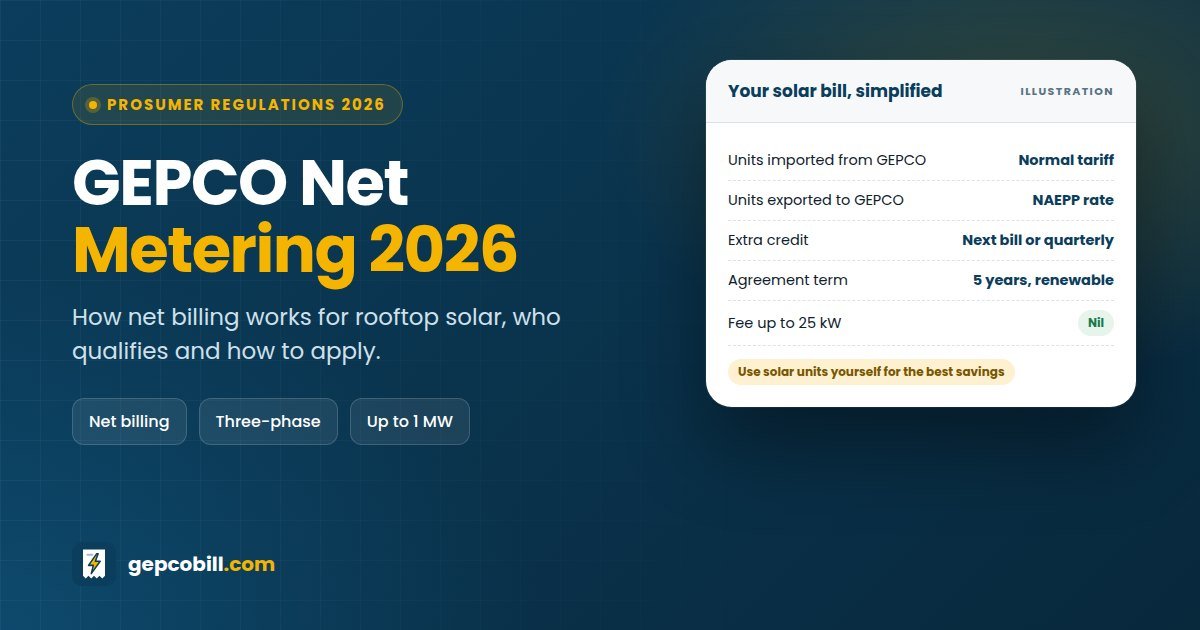
GEPCO net metering changed in 2026. Under NEPRA’s Prosumer Regulations 2026, new rooftop solar users in the GEPCO area join net billing instead. You buy units from GEPCO at the normal tariff and sell your extra units back at a lower national average price.
This guide explains who qualifies, how to apply, what it costs and how your bill works under the new rules. It also covers what happens if you already have a net metering agreement.
On this page
- GEPCO Net Metering vs Net Billing: What Changed
- Already on GEPCO Net Metering?
- Who Can Apply for Net Billing in the GEPCO Area
- How to Apply for GEPCO Net Metering (Net Billing)
- GEPCO Net Metering Costs: Fees and the Green Meter
- How Your Bill Works Under Net Billing
- Is Solar Still Worth It for GEPCO Homes?
- Tips for a Smooth GEPCO Net Metering Application
- Frequently Asked Questions About GEPCO Net Metering
- Plan Your Solar Around Net Billing
- More GEPCO Guides
GEPCO Net Metering vs Net Billing: What Changed
NEPRA notified the Prosumer Regulations 2026 on 9 February 2026. They replaced the 2015 net metering rules for every new applicant, including GEPCO consumers.
| Feature | Old net metering | Net billing (from 9 February 2026) |
|---|---|---|
| How exports are settled | Exported units offset imported units one for one | Exported units are paid at the national average energy purchase price (NAEPP) |
| Agreement term | 7 years | 5 years, renewable by mutual consent |
| Who can apply | Three-phase consumers | Existing three-phase consumers on 400 V or 11 kV |
| System size | Up to 1 MW | 1 kW to 1 MW, and no more than your sanctioned load |
| Approval | DISCO and NEPRA | GEPCO approves systems up to 25 kW; larger ones need NEPRA’s concurrence |
| Fee | Rs 1,000 per kW licence fee | None up to 25 kW; Rs 1,000 per kW for systems larger than 25 kW |
Already on GEPCO Net Metering?
The original 2026 regulations moved existing agreements to net billing. In April 2026, however, NEPRA amended the transition rules through S.R.O. 547(I)/2026, and press reports say agreements signed before 9 February 2026 now keep the old rate and mechanism until they expire.
Because the amended text is not yet easy to read online, ask GEPCO in writing how your agreement is billed. In any case, when your old agreement ends, a renewal follows the 2026 net billing rules.
Who Can Apply for Net Billing in the GEPCO Area
- You are an existing GEPCO consumer with a three-phase 400 V or 11 kV connection
- Your system is between 1 kW and 1 MW
- The system is no larger than your sanctioned load
- Your category is domestic, commercial, industrial, agricultural or general services
- Solar on your transformer is below 80% of its capacity
Systems of 250 kW or more also need a load-flow study, carried out by GEPCO or a PEC-registered consultant.
On a single-phase connection?
Single-phase consumers cannot join net billing. First apply to GEPCO to extend your load and convert to three-phase; our GEPCO new connection guide explains load extension and its time limits.
How to Apply for GEPCO Net Metering (Net Billing)
The regulations set a clear timetable for each step. Here is the process from application to a working meter.
| Step | Time limit under the regulations |
|---|---|
| GEPCO checks your application for completeness | 5 working days |
| You supply any missing documents | 3 working days |
| GEPCO’s technical review | 15 working days |
| Agreement signed | 7 working days after approval |
| Connection charge estimate issued | 7 working days after signing |
| You pay the estimate | 7 working days |
| GEPCO installs the interconnection and meter | 15 working days after payment |
Since S.R.O. 1330(I)/2026 of 6 August 2026, GEPCO approves systems of up to 25 kW on its own. For larger systems, NEPRA must give its concurrence within 7 working days.
GEPCO Net Metering Costs: Fees and the Green Meter
Under S.R.O. 709(I)/2026, there is no application fee for systems of 25 kW or less. A system larger than 25 kW pays a one-time fee of Rs 1,000 per kW to NEPRA.
You also pay for the interconnection and metering. GEPCO fits either one bidirectional meter, often called a green meter, or two separate meters. If GEPCO has no meters in stock, you may buy one, and GEPCO must test it before fitting it.
How Your Bill Works Under Net Billing
Your bill still arrives every month, but imports and exports are now priced separately.
- Units you import from GEPCO are charged at your normal tariff, with fixed charges, adjustments and taxes, just like any other bill.
- Units you export to GEPCO earn a credit at the NAEPP, which NEPRA sets and can revise. Press reports in 2026 put it at about Rs 10–11 per unit.
- If your export credit is larger than your import charges, the difference moves to your next bill or is paid to you quarterly.
Your bill should show meter snapshots for both imported and exported units, as NEPRA’s billing rules require clear reading snapshots. For every other line, see how to read a GEPCO bill.
Is Solar Still Worth It for GEPCO Homes?
Often yes, but the maths has changed. Every solar unit you use yourself saves about Rs 46–48 for a typical unprotected or ToU home: the unit rate, adjustments, F.C. surcharge and GST. In contrast, an exported unit earns only the NAEPP.
Therefore, size your system to your daytime use rather than your whole bill, and ask installers for a payback estimate based on self-use. Our GEPCO bill calculator shows what your current units cost, which is the saving to compare against.
Tips for a Smooth GEPCO Net Metering Application
- Check that your connection is three-phase and your sanctioned load covers the system size
- Ask GEPCO whether your transformer has room for more solar before you buy panels
- Keep the acknowledgement and write down each deadline
- Get the single-line diagram and equipment datasheets from your installer in advance
If GEPCO misses a deadline, raise it in writing and follow our GEPCO complaint guide to escalate.
Frequently Asked Questions About GEPCO Net Metering
01Is GEPCO net metering still available in 2026?
Not for new applicants. Since 9 February 2026, new solar users join net billing under NEPRA’s Prosumer Regulations 2026. Existing net metering agreements continue until they expire.
02Can a single-phase consumer apply for net billing?
No. Only three-phase consumers on 400 V or 11 kV can apply. Convert your connection to three-phase through a load extension first.
03What is the buyback rate under GEPCO net billing?
Exported units are paid at the national average energy purchase price (NAEPP), which NEPRA sets. Reports in 2026 put it at about Rs 10–11 per unit, so check the current figure with GEPCO before you size your system.
04How much does GEPCO net metering cost?
There is no fee for systems up to 25 kW; larger systems pay Rs 1,000 per kW. You also pay for the meter and interconnection, and GEPCO gives you an estimate after you sign the agreement.
05How long does GEPCO take to approve net billing?
If your file is complete, the deadlines in the regulations add up to about 56 working days, or roughly 11 weeks, from submission to installation. That includes the 7 days you have to pay.
06What is the maximum solar size I can connect?
Up to 1 MW, but never more than your sanctioned load. A 10 kW sanctioned load, for example, allows a solar system of up to 10 kW.
07What is a green meter?
It is the common name for a bidirectional meter that records both the units you import and the units you export. You pay for it as part of the interconnection cost.
08What happens to my existing net metering agreement?
NEPRA amended the transition rules in April 2026, and press reports say existing agreements keep the old rate until they expire. Confirm with GEPCO how yours is billed; any renewal follows the net billing rules.
Plan Your Solar Around Net Billing
GEPCO net metering is now net billing, and it rewards solar power you use yourself more than power you export. Check your three-phase connection and sanctioned load, size the system to your daytime use, and keep every deadline in writing.
More GEPCO Guides
Disclaimer: GEPCOBill.com is an independent information service. It is not affiliated with Gujranwala Electric Power Company (GEPCO), Power Information Technology Company (PITC), WAPDA or NEPRA. Rules, rates and contact details can change; your printed bill and official notices are final.
Last reviewed: 29 September 2026 by the GEPCOBill editorial team. Checked against NEPRA (Prosumer) Regulations 2026 and its amendments of April and August 2026.