
GEPCO Peak Hours 2026: Peak and Off-Peak Timings
GEPCO peak hours are the four evening hours when electricity costs more for homes and businesses billed on time-of-use (ToU) meters. From September to November, peak hours run from 6 PM to 10 PM. Below are the timings for every season and the 2026 rates. You will also find simple ways to shift your use and save.
Peak hours change with the season. See the full table below.
On this page
- GEPCO Peak Hours Timings by Season
- Who Pays GEPCO Peak Hours Rates?
- GEPCO Peak and Off-Peak Rates in 2026
- How Much Can You Save by Avoiding GEPCO Peak Hours?
- How Peak Units Show on Your GEPCO Bill
- Tips to Cut Your Use During GEPCO Peak Hours
- Peak Hours Are Not Load Shedding
- Frequently Asked Questions About GEPCO Peak Hours
- Plan Around GEPCO Peak Hours
- More GEPCO Guides
GEPCO Peak Hours Timings by Season
Peak hours move with sunset through the year. All other hours of the day and night count as off-peak.
| Season | Months | Peak hours | Off-peak hours |
|---|---|---|---|
| Winter | December, January, February | 5 PM to 9 PM | All other hours |
| Spring | March, April, May | 6 PM to 10 PM | All other hours |
| Summer | June, July, August | 7 PM to 11 PM | All other hours |
| Autumn | September, October, November | 6 PM to 10 PM | All other hours |
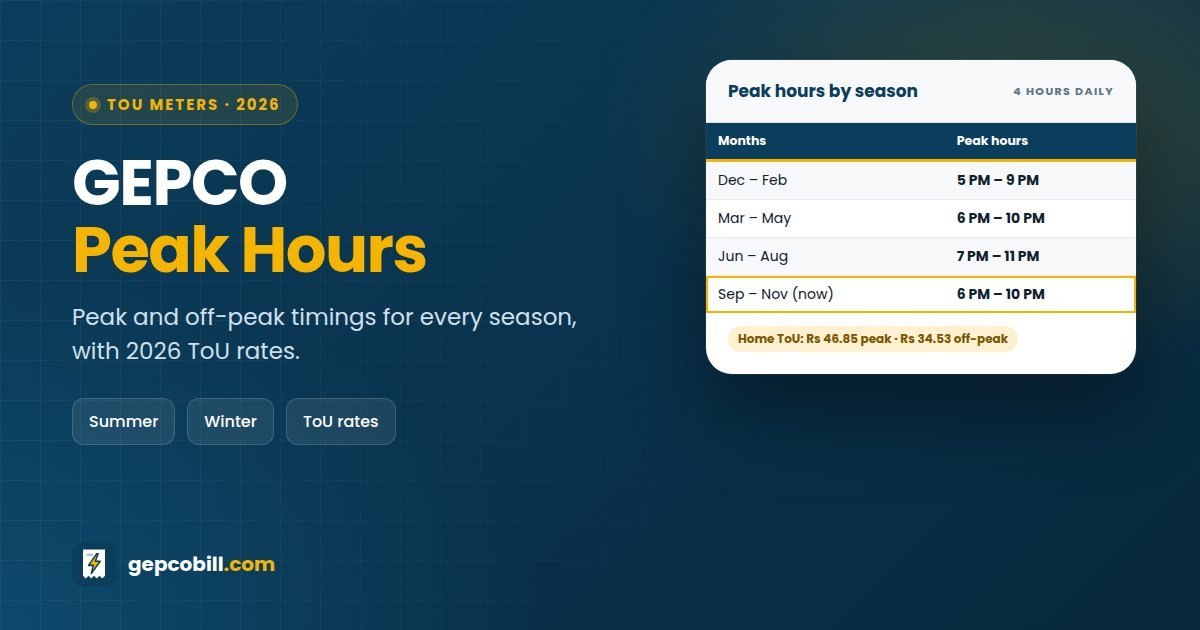
These timings are the same for GEPCO and the other government-owned DISCOs. K-Electric in Karachi uses different timings, so do not mix the two.
Who Pays GEPCO Peak Hours Rates?
Peak rates apply only to connections with a ToU meter, which records peak and off-peak units separately. Most small homes do not have one.
| Connection | Tariff | Billed on peak and off-peak? |
|---|---|---|
| Homes below 5 kW sanctioned load | A-1(a) | No, normal slab rates at any hour |
| Homes with 5 kW or more | A-1(b) | ✓ Yes |
| Shops and offices with 5 kW or more | A-2(c) | ✓ Yes |
| Industry | B-1(b) to B-4 | ✓ Yes |
NEPRA’s Consumer Service Manual covers homes that grow. When a single-phase home’s load approaches 5 kW, GEPCO sends a load-extension notice and installs a ToU meter. So check the tariff code on your bill: A-1a means you are not on peak pricing.
GEPCO Peak and Off-Peak Rates in 2026
These rates come from NEPRA’s tariff decision of 11 February 2026. As on any bill, GEPCO then adds fuel and quarterly adjustments, the F.C. surcharge and taxes.
| Tariff | Peak (Rs per unit) | Off-peak (Rs per unit) | Fixed charge |
|---|---|---|---|
| A-1(b) homes, 5 kW and above | 46.85 | 34.53 | Rs 675 per kW |
Commercial ToU connections on A-2(c) pay a fixed charge of Rs 1,250 per kW, and industrial tariffs have their own peak and off-peak rates in the same NEPRA decision.
For A-1(b) homes, the fixed charge applies to half the sanctioned load or the maximum demand the meter records (MDI), whichever is higher. For the non-ToU slab rates, see our GEPCO unit price page.
How Much Can You Save by Avoiding GEPCO Peak Hours?
For a ToU home, each unit moved from peak to off-peak saves Rs 12.32 before tax (Rs 46.85 minus Rs 34.53). With 18% GST, that is about Rs 14.54 per unit.
| Units moved out of peak hours each month | Saving before tax (Rs) | Saving with GST (Rs) |
|---|---|---|
| 25 | 308 | 363 |
| 50 | 616 | 727 |
| 100 | 1,232 | 1,454 |
| 150 | 1,848 | 2,181 |
For example, running a 1.5-ton inverter air conditioner two hours later each evening can easily move 50 units a month out of peak time.
How Peak Units Show on Your GEPCO Bill
A ToU bill shows two sets of readings: one for peak units and one for off-peak units, each with a meter snapshot. It also records the maximum demand indicator (MDI), which can affect the fixed charge.
Check that the peak and off-peak units add up to your total, and that both snapshots match the printed readings. Our guide on how to read a GEPCO bill explains the other lines.
Tips to Cut Your Use During GEPCO Peak Hours
- Run washing machines, irons and water pumps before peak hours begin
- Pre-cool rooms before peak time, then raise the AC to 26–27°C
- Charge UPS batteries and devices during off-peak hours
- Use timers or smart plugs so heavy loads start after peak hours end
- If you have solar, use daytime solar for cooling and pumping
Peak Hours Are Not Load Shedding
Peak hours only change the price of a unit; they do not cut your supply. Load management is a separate schedule for feeders with high losses or shortages.
If your supply fails, call 118 or see our GEPCO helpline page for the right number.
Frequently Asked Questions About GEPCO Peak Hours
01What are GEPCO peak hours right now?
From September to November, GEPCO peak hours are 6 PM to 10 PM. From 1 December they move to 5 PM to 9 PM for the winter.
02What are GEPCO peak hours in winter?
From December to February, peak hours run from 5 PM to 9 PM. All other hours are off-peak.
03What are GEPCO peak hours in summer?
From June to August, peak hours run from 7 PM to 11 PM, when evening cooling demand is highest.
04Do GEPCO peak hours apply to my home?
Only if you have a ToU meter, which usually means a sanctioned load of 5 kW or more on the A-1(b) tariff. Homes on A-1(a) pay normal slab rates at any hour.
05What is the GEPCO peak hours rate per unit?
For A-1(b) homes in 2026, the peak rate is Rs 46.85 and the off-peak rate is Rs 34.53 per unit, before adjustments, the F.C. surcharge and tax.
06How do I know if I have a ToU meter?
Check the tariff code on your bill. A-1b, A-2c or an industrial B code means ToU billing, and the bill shows separate peak and off-peak readings.
07Are GEPCO peak hours the same as LESCO and IESCO?
Yes. The government-owned DISCOs use the same seasonal timings. K-Electric in Karachi sets its own.
Plan Around GEPCO Peak Hours
If you are on a ToU meter, a little planning around GEPCO peak hours pays off every month. Move heavy loads a few hours earlier or later, and check the live card at the top of this page whenever the season changes.
More GEPCO Guides
Disclaimer: GEPCOBill.com is an independent information service. It is not affiliated with Gujranwala Electric Power Company (GEPCO), Power Information Technology Company (PITC), WAPDA or NEPRA. Rules, rates and contact details can change; your printed bill and official notices are final.
Last reviewed: 29 September 2026 by the GEPCOBill editorial team. Rates checked against NEPRA’s tariff decision of 11 February 2026.